Free Classroom Packs — One for Every Book in the Series
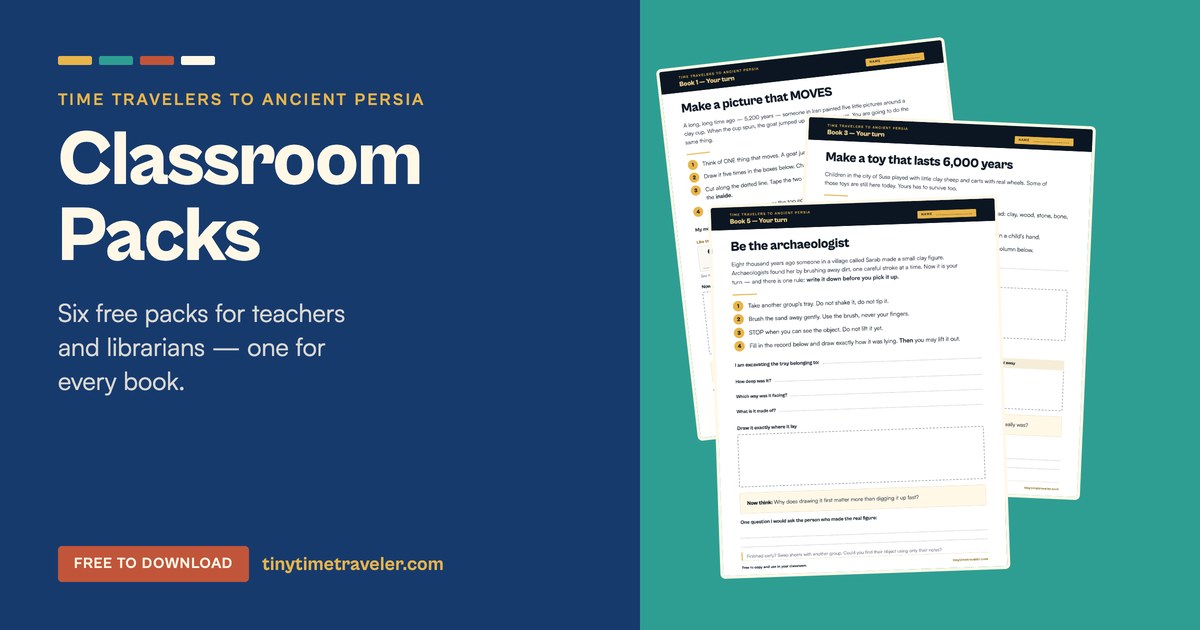
Six free classroom packs are now on the site, one for every book in the series. Each is two pages: a teacher's page with the big question, vocabulary, discussion prompts and the misconceptions to watch for — and a student sheet with a hands-on activity. Everything uses paper, straws, foil, clay and sand.
Teachers and librarians have been asking the same thing: the books are lovely, but what do I actually do with them in a classroom?
So we made something. There are now six free classroom packs on the site, one for every book in the series. No sign-up, no email address, no form. Download the PDF and photocopy it.
Two Pages, and They Do Different Jobs
Each pack is two pages, because a teacher and a seven-year-old need very different things.
Page one is for the teacher. It opens with one big question to put to the whole class — for Book One, what can an object tell us about people who left no writing behind? Then the words children will need, four discussion questions, a quick way to check they understood, and a short note on what students commonly get wrong.
That last section is the one we are most pleased with. For Book One it includes this: "first" is not a fact, it is a claim about evidence — it means the oldest one anybody has found so far. That is how archaeologists actually talk, and children can handle it.
Page two is for the child. This is the sheet you photocopy and hand out: the activity itself, room to draw, a question to think about at the end, and something extra for whoever finishes early.
The Same Question for Every Child
One thing we were careful about. The discussion questions are not sorted into easy ones for younger children and interesting ones for older children.
Every child gets the same question. What changes is the support underneath it — a sentence to start them off, like "This cup tells me they knew how to…" A six-year-old who needs a way in gets a way in. They do not get a lesser question.
What the Children Actually Make
Every activity uses things a classroom already has.
- Book 1 — Draw five pictures, spin them, and watch them move. It is exactly what an artist did on a clay goblet 5,200 years ago. The sheet includes a worked example so children can see what "change it a little each time" means.
- Book 2 — Five drinking straws cut to five lengths, and children discover for themselves the rule the maker of the world's oldest flutes already knew.
- Book 3 — Design a toy a child in Susa could have owned, using only clay, wood, stone, bone, string and cloth. Then work out which parts of it would still be there after six thousand years underground.
- Book 4 — Press a design into kitchen foil, the way the metalworkers of Shahdad hammered theirs.
- Book 5 — Bury a clay figure, swap trays with another group, and excavate it with a brush. There is one rule, and it is the real rule on a dig: record it before you lift it.
- Book 6 — Map every language spoken in the room, and each child teaches the class one word.
Two of Them Teach Something Bigger
Book 3 and Book 5 are quietly about how we know anything at all.
Book 3's sorting task — what survives burial and what rots away — is a lesson in why the past looks poorer than it was. Clay lasts. Cloth, wood and basketry do not. Almost everything we find is made of the few materials that happen to endure, and children work that out themselves by looking at their own toy.
Book 5 teaches the thing every archaeologist learns first. An object pulled out of the ground without a record loses most of what it could have told us. Where it lay, how deep, which way it faced — that is the information. The object is only part of it.
Free, and Free to Copy
Print them, copy them for your class, put them in a library holiday pack. There is nothing to sign up for.
If you are ordering books for a school or library, there is a 15% discount — details on the bulk orders page.
And if you use a pack with your class, we would genuinely like to hear how it went. Especially if something did not work.