Knowing Where We Come From Helps Us Imagine Where We Can Go
Research on ethnic identity and family storytelling suggests that cultural knowledge can be a real protective resource for children growing up between two worlds.
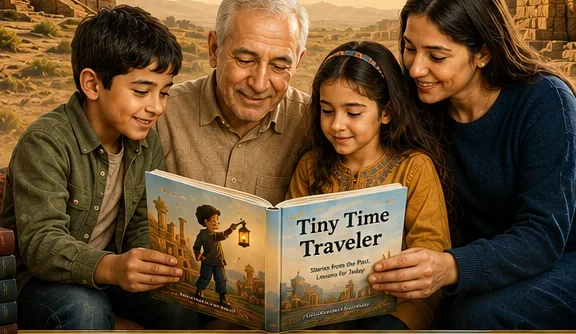
Children growing up in the diaspora often live between two worlds. They learn the language, customs, and history of the country where they live, while their family heritage may remain distant — present in names, foods, celebrations, and family memories, but not always fully understood.
For these children, learning about the past is more than memorizing kings, wars, and dates. It can help answer three deeply personal questions:
Who am I? Where do I belong? What can I become?
Cultural knowledge can strengthen identity
Scientific research shows that a positive understanding of one's ethnic and cultural identity is associated with important psychological and educational benefits.
A major meta-analysis by Deborah Rivas-Drake and her colleagues examined 46 studies involving ethnic and racial minority youth. The researchers found that positive feelings about one's heritage were associated with higher self-esteem, greater well-being, healthier social functioning, more positive academic attitudes, and fewer depressive symptoms. The effects were generally small to moderate, meaning that cultural identity is not the only influence on a child's development, but it can be a meaningful protective resource.
The study, published in Child Development, suggests that children benefit when they can feel informed, secure, and proud — not superior — about their cultural background.
Research led by Adriana Umaña-Taylor also describes ethnic and racial identity as an important part of normal adolescent development. Young people gradually explore what their heritage means, decide which values matter to them, and integrate those discoveries into a larger understanding of themselves.
Diaspora children do not have to choose between two identities
Children of immigrants sometimes feel they must choose between the culture of their family and the culture of the country in which they are growing up. Research indicates that this does not have to be the case.
A longitudinal study of 765 immigrant adolescents found that personal, ethnic, and national identities were interconnected. The findings suggest that exploring one's heritage can be part of the broader process through which young people develop a coherent understanding of themselves.
The healthiest message for diaspora children is therefore not, "You belong only to the past," or, "You must choose one country over another." It is:
You can understand your ancestral heritage, participate fully in the society where you live, and build an identity that includes both.
Stories connect children to generations before them
Family stories and historical narratives can also provide children with a sense of continuity.
Research by Robyn Fivush, Jennifer Bohanek, and Widaad Zaman found that adolescents whose intergenerational stories contained stronger family connections and greater perspective-taking showed higher levels of well-being. Stories about previous generations can help children understand that they belong to something larger than themselves.
They learn that earlier generations also faced uncertainty, migration, hardship, change, and difficult decisions. Most importantly, they discover that those generations responded with creativity, courage, cooperation, and perseverance.
The past can become a source of hope
The scientific evidence does not mean that simply reading a history book will automatically make every child confident or hopeful. Children's well-being is also shaped by family relationships, education, economic conditions, discrimination, friendships, and many other experiences.
The research does, however, support an important pathway:
Knowledge can create connection. Connection can strengthen identity. A secure identity can support confidence, belonging, and hope.
When diaspora children learn that their ancestors built cities, developed systems of writing and accounting, created art, practiced agriculture, exchanged ideas, and overcame crises, history no longer appears as a collection of lifeless ruins.
It becomes evidence of human possibility.
A child who learns about the achievements of the past may begin to think:
"People from my heritage created, discovered, and contributed to civilization. Their story is part of my story. I, too, can learn, create, and contribute."
This is why presenting history to children through accurate, engaging, and age-appropriate stories matters. Historical knowledge should never be used to claim superiority over others. Its best purpose is to give children roots without limiting their wings.
For diaspora children, the past should not become a place in which they are trapped. It should become a foundation from which they can look toward the future — with greater self-knowledge, self-confidence, and hope.
If you would like to explore this further, we've also written about why Iranian diaspora children should learn about Iran's 12,000-year history, and the Tiny Time Traveler books are our own attempt at telling that story in a way children can hold onto.
Sources
- Rivas-Drake, D., Syed, M., Umaña-Taylor, A., French, S., Schwartz, S. J., & Lee, R. (2014). Feeling good, happy, and proud: A meta-analysis of positive ethnic–racial affect and adjustment. Child Development, 85(1), 77–102.
- Umaña-Taylor, A. J., et al. (2014). Ethnic and racial identity during adolescence and into young adulthood: An integrated conceptualization. Child Development, 85(1).
- Mastrotheodoros, S., Kornienko, O., Umaña-Taylor, A., & Motti-Stefanidi, F. (2021). Developmental interplay between ethnic, national, and personal identity in immigrant adolescents. Journal of Youth and Adolescence.
- Fivush, R., Bohanek, J. G., & Zaman, W. (2011). Personal and intergenerational narratives in relation to adolescents' well-being. New Directions for Child and Adolescent Development, 2011(131), 45–57.