Book Six Is Here: The Girl Who Had Two Languages
The sixth Tiny Time Traveler book is about a question many children carry quietly: am I this, or am I that? Ariana takes it back four thousand years to the ancient city of Susa.
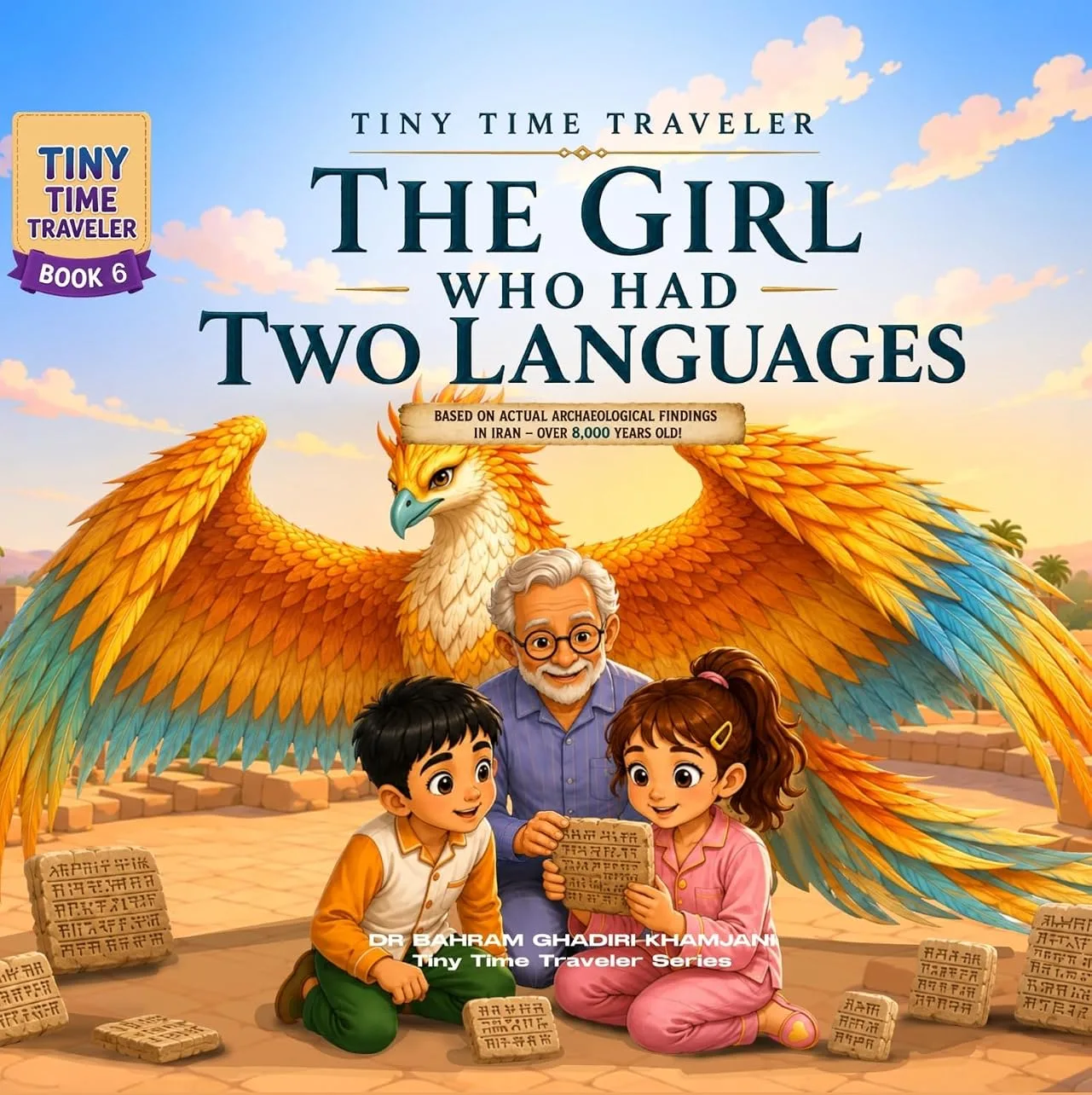
The sixth book in the Tiny Time Traveler series is now available: The Girl Who Had Two Languages.
It began with a question I have heard from a great many children, usually asked quietly, and often not asked at all: am I American, or am I Iranian?
Children who grow up between two languages learn early that the answer is supposed to be one or the other. They hear one language at school and another at their grandmother's table. They have a name teachers stumble over. Somewhere along the way, many of them decide that the second language is a complication — something to keep at home, out of sight.
This book is my answer to that.
The night before a new school
Ariana cannot sleep. Tomorrow is her first day at a new school, and she is turning the question over: am I American, Iranian… or both?
Then Homa comes for her — as she has in every book — and carries Ariana and her brother Aryan far back in time to the ancient city of Susa. There they meet Niloufar, a girl who speaks two languages and cannot understand why anyone would think that a problem. To Niloufar, two languages are simply two ways of reaching people. She has never once thought of it as being half of anything.
Ariana comes home with her question answered, though not in the way she expected.
Why Susa
I chose Susa deliberately, and not only because it is one of the oldest cities on earth.
Susa sat where worlds met. Over its long life the city held people who spoke different languages and wrote in different scripts, side by side, in the same streets and the same records. Later, when the Achaemenid kings carved their great inscriptions, they did not choose one language — they wrote in three, so that everyone who passed could read them.
This is the part I most wanted children to have. A child who speaks two languages sometimes feels like an exception, a complication, a modern problem. She is not. She is standing in a very old and very distinguished line. Multilingual cities are not a departure from history. For much of human history, they were history.
For the children this book is for
Earlier this month I wrote about what the research says about heritage and children growing up between two worlds — that knowing where you come from is not nostalgia, but a genuine resource a child can draw on.
The Girl Who Had Two Languages is that idea in story form. It is for the child who has stopped answering her grandmother in Persian. It is for the boy who winces when a teacher reaches his surname on the register. And it is for the classroom around them, where the other children learn that the friend with two languages is carrying something worth having.
Two languages. Two worlds. One extraordinary gift.
Where to find it
The book is available now on Kindle, with hardcover and paperback editions coming soon. It is written for ages 3–12 and reads aloud well.
Schools and libraries can order any title in the series in bulk at a 15% discount, and I am always glad to visit a school for a storytelling session.